
The problem is not that your team has too many documents. The problem is that, when an opportunity arrives, nobody knows for certain which one contains the answer that can be used.
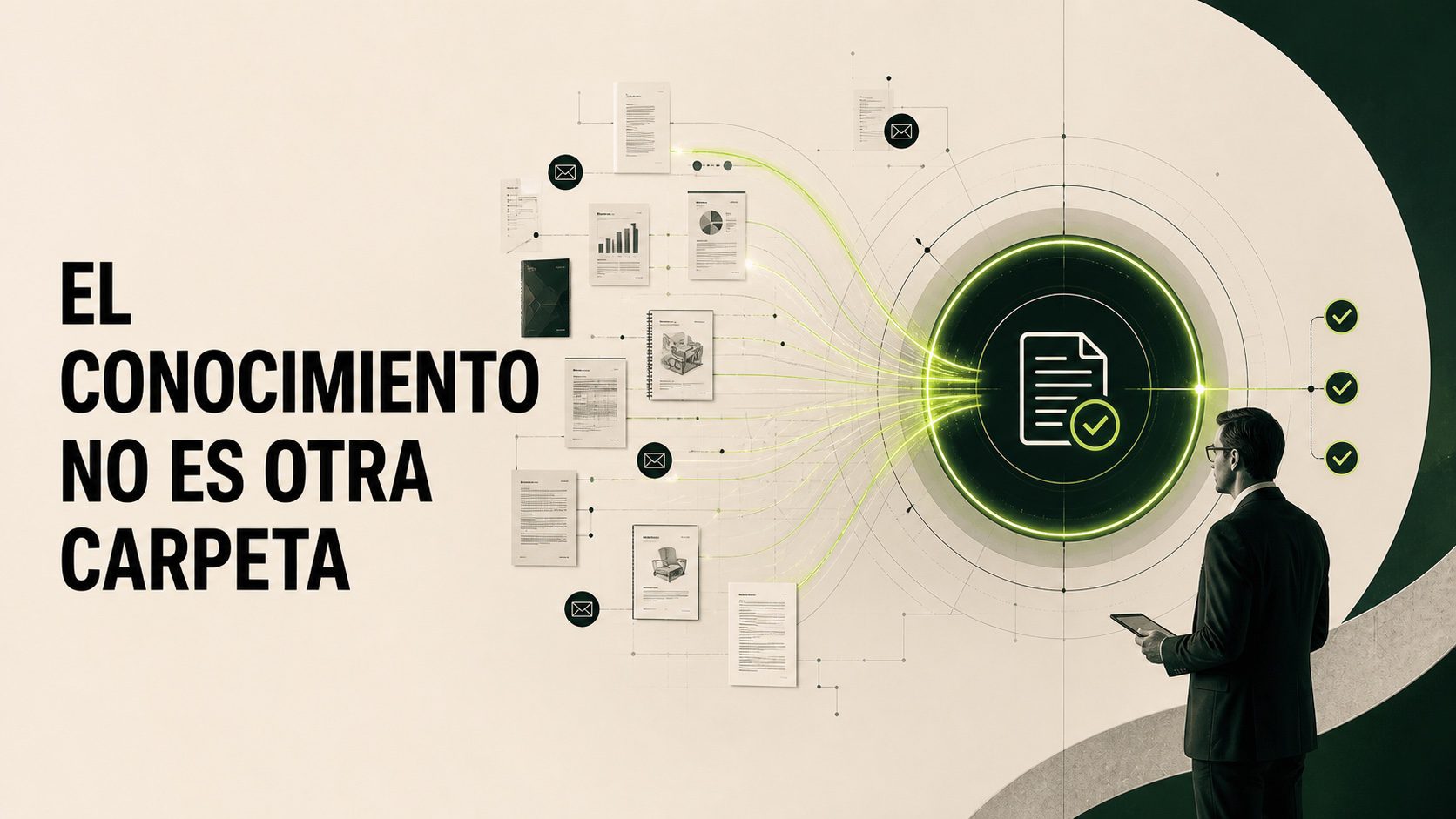
Some companies spend hours on a proposal not because they lack capability, but because they lack confidence in the available information. A product sheet is in a shared folder. A customer case lives in someone’s presentation. The answer to an objection appears in an old email. And the person who “knows where everything is” unintentionally becomes a critical part of the commercial operation.
Centralizing knowledge does not mean dragging all those files into a new tool. It means deciding which information is valid, who is accountable for it, when it is reviewed, and how it is used without losing the connection to its source.
A folder is not a commercial knowledge system
An organized folder may be necessary. By itself, it does not answer the questions that matter in a commercial conversation: Is this statement still valid? Who approved it? Does it apply to this customer? Is it the latest version? Which part needs technical or contractual confirmation?
A commercial knowledge system answers those questions before the team has to improvise. It may exist on a simple or complex platform. What matters is not the name of the tool, but four properties:
- Identifiable source. Every important answer can be traced to a known document, data point, or owner.
- Validity. The team knows whether content is approved, under review, historical, or withdrawn.
- Accountability. A person or function can validate an update.
- Controlled use. The team knows when an answer may go to a customer and when it requires additional review.
Evidence does not turn a repository into a promise
A longitudinal study published in Information Systems Research followed 2,154 salespeople at a pharmaceutical company for 24 months and observed a positive and significant relationship between use of a codified knowledge system and individual performance. The result is interesting because it occurred in a real sales organization over time. It also has an important limitation: it concerns one specific pharmaceutical company; it does not demonstrate increased sales for every SME, industry, or commercial team.
The useful conclusion is more modest and more practical. When knowledge becomes accessible and reusable, the quality of its use depends on how it is structured, the person’s experience, and the work context. Accumulating documents is not enough.
Start with five recurring questions
Do not begin with a large-scale migration. For two weeks, collect the questions that repeat most often in commercial conversations. For example:
- What can we state about this product or service?
- Which similar case can we cite, and within what limits?
- What is and is not included in this proposal?
- How did we previously respond to this objection?
- Which terms must another person confirm before sending?
These questions reveal where the team currently loses time or risks answering with information it cannot support. They also help determine which sources matter first. The goal is not to capture everything. It is to make useful the answers that most affect commercial progress.
Classify knowledge before asking AI for answers
A simple classification reduces the risk of treating everything as equal. E2M recommends four operating states:
| Status | What it means | How it should be used |
|---|---|---|
| Approved | A reviewed, current source for a defined use. | May support an answer or draft within its boundaries. |
| Working | Useful content that is incomplete or awaiting review. | May support internal research, not final statements. |
| Historical | Describes previous experiences or versions. | May add context; must be checked before reuse. |
| Withdrawn | Obsolete, incorrect, or unauthorized content. | Should not appear as an available source. |
In addition to that status, every critical source needs an owner and a review date. This is not bureaucracy. It is the difference between a retrievable answer and a defensible one.
NIST’s generative AI profile highlights the importance of provenance, transformations, and traceability. In commercial work, that becomes a concrete practice: if a system suggests an answer for a customer, the person reviewing it must be able to return to the original source and decide whether it remains appropriate.
The useful workflow: ask, retrieve, review, use
AI does not have to be a box that simply answers. It can be part of a workflow that keeps the boundaries of the answer visible:
- A person asks a specific commercial question.
- The system retrieves approved sources and identifies their origin.
- AI organizes a draft or response with internal citations.
- The human owner reviews, corrects, and decides how it may be used.
- If the answer is reused, the learning returns to the system with a date and owner.
This workflow can reduce search time without delegating credibility. It also prevents a team from confusing the ease of obtaining a sentence with the confidence required to send it.
What should not be centralized yet
Not everything belongs in the first repository. Confidential documents, customers’ personal information, restricted-access contracts, or unreviewed content require specific access and handling rules. Nor is it advisable to load thousands of files at once simply to say that a knowledge base exists.
A reasonable initial scope might cover one product line, one proposal type, or one set of recurring questions. The company can then learn which sources are missing, which content becomes obsolete, and who must intervene before expanding.
How to measure whether knowledge is becoming useful
The best signals are operational, not decorative:
- Commercial questions that remain unanswered after a search.
- Sources that cause corrections or contradictions.
- Search time before a proposal or meeting.
- Content reused without an identifiable owner.
- Answers requiring additional review before reaching a customer.
The first measurement does not need to be perfect. It helps reveal whether the company needs to improve a source, a definition, a permission, or part of the commercial process.
If the next problem is preparing quotes or proposals, the following step may be the guide to proposals and quotes. If continuity is lost after meetings, it is worth reviewing CRM and commercial follow-up. Knowledge is useful when it helps determine the next move, not when it merely fills a library.
Does the commercial team depend on what certain people remember?
E2M can review which questions, sources, and owners should make up the first scope of a more reliable commercial system.
Sources and limits of this guide
- Information Systems Research: Sales Force Productivity and the Use of a Sales Force Automation System. A longitudinal study at one pharmaceutical company; it does not demonstrate universal results.
- NIST AI Risk Management Framework, Core. A voluntary risk management framework.
- NIST AI 600-1. A generative AI risk profile; it does not replace applicable privacy, security, or compliance controls.