
A CRM does not improve because it produces more notes. It improves when every conversation leaves a decision: which opportunity moves forward, what information is missing, who takes action, and when.
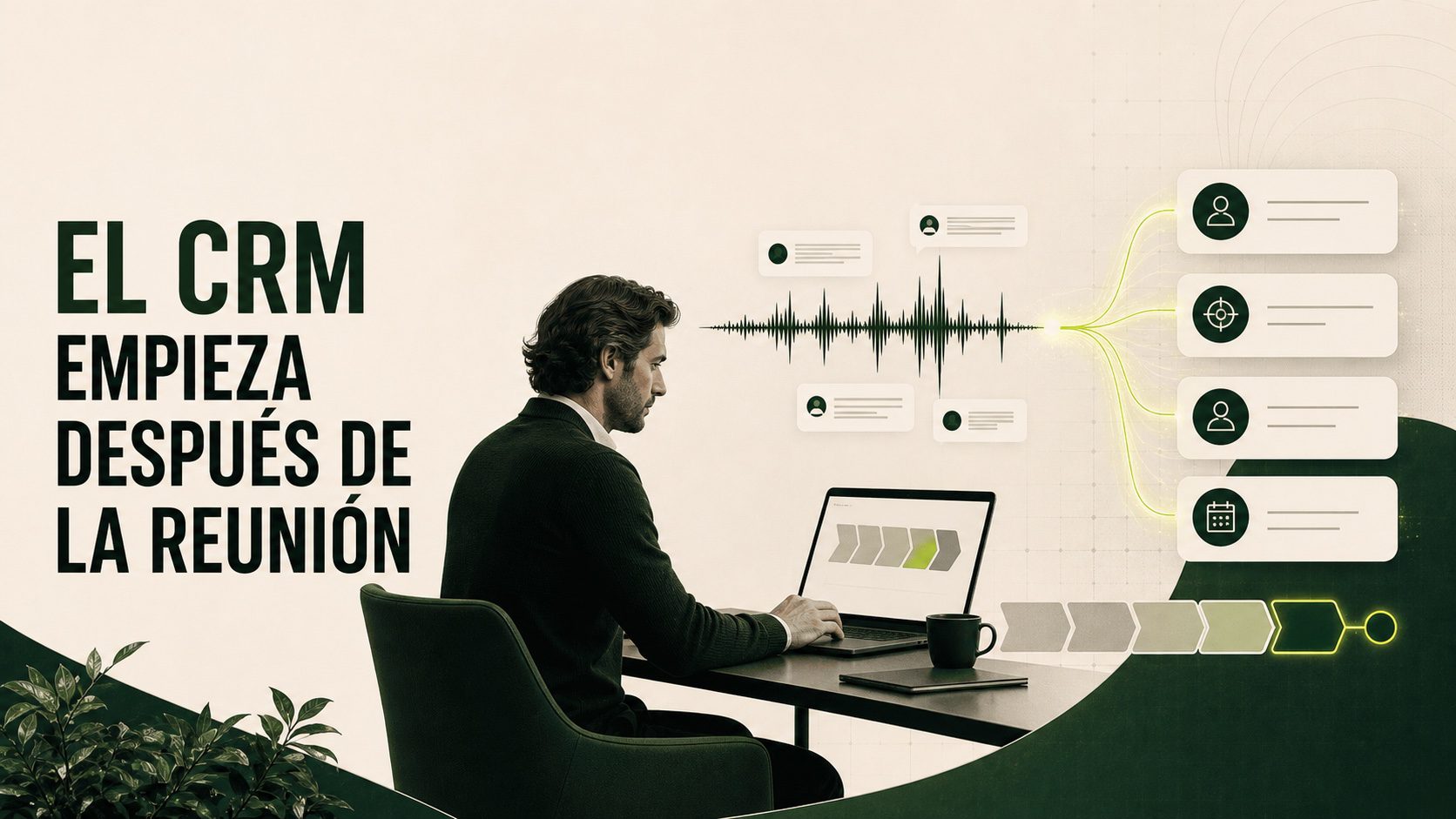
In many companies, the CRM does not fail at the end of the month. It fails on Tuesday, after a meeting. Someone heard an important need, promised to send something, or identified a risk. Then other matters take over, the note remains in a notebook or an email, and the next action loses momentum. The CRM ends up reflecting a delayed version of what happened.
Artificial intelligence can be useful in that interval. Not to decide who will buy or to change an opportunity’s stage automatically, but to help turn information from a conversation into a reviewable draft: summary, commitment, risk, missing information, and a proposed next action.
The problem is not simply “a bad CRM”
Saying that a CRM is out of date often hides a more specific problem: the team does not have a simple, reliable way to translate conversations into commercial continuity. Sometimes fields are missing. Sometimes there are too many. Often, what is missing is a shared rule: after a relevant conversation, someone decides what is recorded, what is reviewed, and what happens next.
That is why the first use case should not be “automate the CRM.” It should be a tightly defined workflow:
- A meeting, call, or commercial exchange generates information.
- A system proposes a summary and candidate fields from authorized sources.
- The responsible person reviews and corrects the draft.
- The CRM receives a validated update.
- The opportunity is left with a next action, an owner, and a date.
The value of this workflow is not measured by the number of completed fields. It is measured by whether the team can resume an account without rediscovering what was already discussed.
What AI can do usefully
Turn a conversation into a context draft
Given a transcript or notes the company is legitimately allowed to use, AI can propose a structured summary: customer situation, stated need, stakeholders, objections, timelines, risks, and open questions. The result should remain a draft, not an automatic truth.
Propose CRM updates
If the team has already defined its commercial fields, an assistant can suggest what to update. Examples include the next step, follow-up date, identified decision-maker, stage requiring review, or requested document. This is more useful than asking AI to “fill in the CRM,” because each proposal can be checked against a specific source.
Prepare follow-up without sending it on its own
After a meeting, the system can draft an email covering agreements, questions, and next steps. The responsible person still reviews the tone, accuracy, promises, and timing. The first draft accelerates continuity; the decision to communicate remains commercial and human.
Identify opportunities with no next action
Within an already structured dataset, AI or a process rule can help locate opportunities that have gone too long without activity, overdue tasks, or contacts without follow-up. It is important to distinguish a signal from a decision: the tool may point out an absence; the owner must interpret why it exists and what to do about it.
Prepare a meeting with approved context
An account briefing can bring together previous proposals, recent interactions, stated risks, and pending tasks. The condition is that sources are identified and the team can return to them when a detail needs to be verified.
Evidence helps define boundaries, not make promises
An NBER working paper analyzed the use of a generative assistant by 5,179 customer support agents and observed an average 14 percent increase in issues resolved per hour. The study matters because it shows the potential of contextual support in real interactions. It is not proof that a B2B CRM will achieve that percentage: the study involved customer support, a different metric, and a different operating environment.
The useful lesson is not the number. It is that support appears to be more valuable when it is integrated into a specific workflow and when the user has the information and judgment needed to act. In B2B sales, that principle suggests starting with conversations, tasks, and sources the team already recognizes.
The NIST AI Risk Management Framework emphasizes defined oversight roles, context, and evaluation measures. Applied to CRM, that becomes a simple rule: AI may propose the record; a person validates it before a proposal changes an opportunity or reaches the customer.
What it should not do without human review
- Change an opportunity stage on its own.
- Invent information about an account, a need, or a decision-maker.
- Send follow-up emails without validation.
- Decide discounts, prices, committed dates, or terms.
- Close, reopen, or discard opportunities automatically.
These boundaries do not make the process less modern. They make it more defensible. Good automation removes repetitive work without obscuring who is accountable for a commercial promise.
How to design a controlled first pilot
Choose one team, one type of meeting, or one commercial stage. Define which sources are included, which fields may be proposed, and who reviews each draft. Start with a small volume and cases the team can compare with what it would have done without assistance.
Before scaling, observe five measures that belong to the workflow:
- Percentage of active opportunities with a next action, owner, and date.
- Time from a meeting to a reviewed CRM update.
- Number of material corrections required before saving or sending.
- Age of pending commercial tasks.
- The owner’s ability to recover an account’s context without searching in several places.
None of these measures is a commitment to a result. They are signals for deciding whether the workflow is useful and whether it should be expanded, adjusted, or stopped.
When it is better to start elsewhere
If the company does not know what it should record, if the definition of an opportunity changes from one person to another, or if nobody is responsible for reviewing changes, automating the CRM is not the first step. It may be more sensible to start by organizing commercial knowledge or describing the current follow-up process before adding an AI layer.
Does commercial follow-up get lost between meetings, emails, and tasks?
E2M can review the current workflow and assess whether there is a reasonable first pilot, with approved sources and human review.
Sources and limits of this guide
- NBER, Generative AI at Work. A customer support study; it does not measure B2B CRM, sales, or results for an E2M client.
- NIST AI Risk Management Framework, Core. A voluntary risk management framework; it is not a performance guarantee or legal advice.