
Automation does not fix a process nobody has defined. It only makes the disorder reach the next step faster.
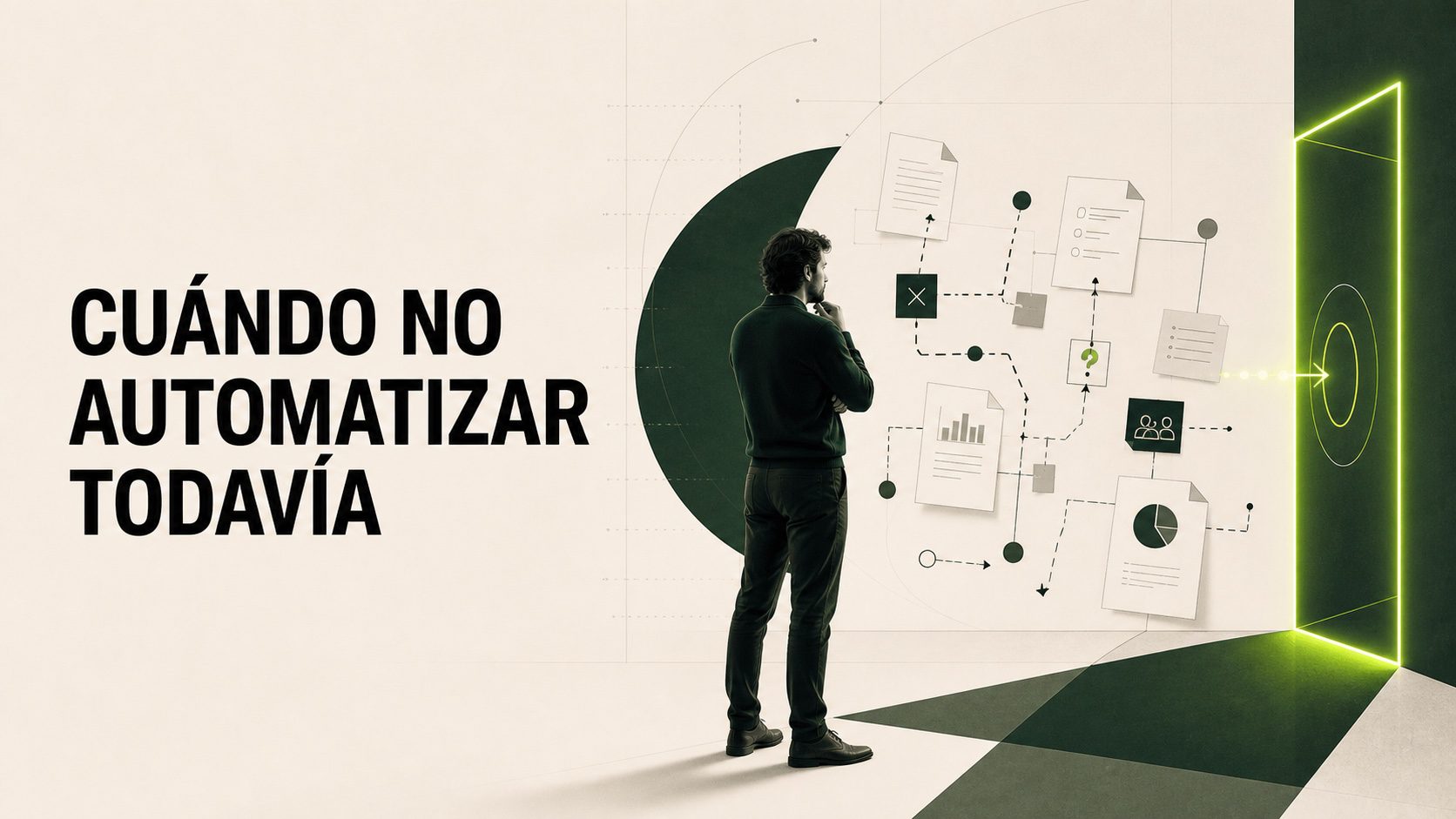
Saying “not yet” to automation can be a mature business decision. For an SME, the cost of moving too early is not just a license. It is the time people spend correcting results, resolving exceptions, explaining inaccurate information to customers, and losing confidence in a project that could have started differently.
The right question is not “Can we automate this?” It is “Do we have a process, a source of information, and a responsible person that allow us to test it without creating more confusion for the team?”
AI adoption requires more than intention
In 2025, the OECD reported that approximately 10.4 percent of Spanish SMEs say they use AI applications. The report links the gap to factors such as awareness, skills, regulatory concerns, resources, and integration with existing systems. The figure describes the Spanish context; it does not measure the readiness of a specific company or mean that every other SME should rush to buy a tool.
The OECD has also noted that data, capabilities, skills, and financing enable AI adoption among SMEs. The practical message is clear: maturity is not demonstrated by a demo. It is demonstrated by the ability to place a process under observation and learn from it.
Seven signs that it is not yet time to automate
1. Nobody can describe the current commercial process
If three people explain differently how an opportunity is received, qualified, prepared, or followed up, there is no sequence to automate. First, the company needs to define the minimum process: what starts it, who participates, what output is expected, and which exceptions are normal.
2. Nobody is accountable for exceptions
Every commercial workflow has cases that do not fit. If nobody can resolve an exception, approve a change, or correct an output, automation turns that lack of accountability into a faster problem.
3. Definitions change depending on who answers
“Active customer,” “qualified opportunity,” “proposal sent,” or “next action” cannot mean something different to each person. AI does not correct those semantic differences; it may amplify them if it learns from contradictory records.
4. Critical information is obsolete, duplicated, or has no identifiable source
If nobody knows which document is current, which price is approved, or which term remains in use, a generative tool can produce convincing text from an incorrect foundation. The first task is not to automate the answer. It is to establish which sources may be used.
5. There are no real examples for checking the result
A pilot needs specific cases. Without them, the company can only evaluate a generic demonstration. Select samples that include a normal case, an incomplete one, and a common exception to see how the workflow responds and where a person must intervene.
6. Automation affects decisions about people without proportionate review
When an output influences how people are prioritized, treated, or evaluated, the level of caution must increase. Guidance from the UK regulator, the ICO, reminds organizations to consider whether automation is appropriate for the purpose, assess the necessary accuracy, and monitor the system. This is UK regulatory context, not legal advice for every country or company.
7. The team lacks capacity to review and improve the workflow
A commercial system does not become useful the day it is connected. It requires source review, case correction, training, and a regular conversation about what is working. If the team cannot devote time to that work, it is better to reduce the scope than to create automation nobody can sustain.
What to do instead of automating today
“Not yet” does not mean “never.” It means preparing the conditions for a safer, more useful first test.
- Describe the current workflow on one page. Starting point, steps, people, tools, output, and exceptions.
- Choose one commercial friction. For example, search time before a proposal or opportunities with no next action.
- Define the sources and the owner. Which information may be used, who corrects it, and which decisions remain human.
- Gather examples for testing. Real, authorized cases proportionate to the risk.
- Decide how the pilot will be assessed. Search time, review quality, follow-up continuity, or unanswered questions.
These actions do not require a complete transformation. They are a way to prevent a pilot from becoming a collection of promises that are difficult to support.
Process quality matters more than enthusiasm
The NIST framework proposes governing, mapping, measuring, and managing AI risks. For an SME, the translation does not have to be bureaucratic: know which problem the company is trying to solve, which information enters the workflow, who reviews it, what will be measured, and what happens if the result is not acceptable.
A company that delays automation to answer those questions is not falling behind. It is avoiding the mistake of confusing speed with progress.
When to reconsider a pilot
An initial automation may make sense when the process already repeats, an internal owner exists, sources are identifiable, and the result can be reviewed before it affects a customer. The pilot should be small, reversible, and measurable.
If the friction is in knowledge, start by centralizing commercial sources. If it is in follow-up, review CRM and next actions. If it appears while preparing offers, the focus may be proposals and quotes. The first pilot does not need to solve everything. It needs to teach the company something reliable.
Is it unclear whether the team is ready to automate?
E2M can review one priority commercial process, its sources, and its boundaries to decide whether the right next step is to prepare, test, or wait.
Sources and limits of this guide
- OECD Economic Surveys: Spain 2025. A contextual figure about Spanish SMEs; it is not a diagnostic of a specific company.
- OECD, AI adoption by SMEs. Analysis of adoption enablers and barriers.
- NIST AI Risk Management Framework, Core. A voluntary risk management framework.
- ICO: Accuracy and AI. UK guidance; it does not replace a legal review applicable to each case.