
AI should not decide what a company promises. It can help find, organize, and turn approved knowledge into a first draft the team can discuss and validate.
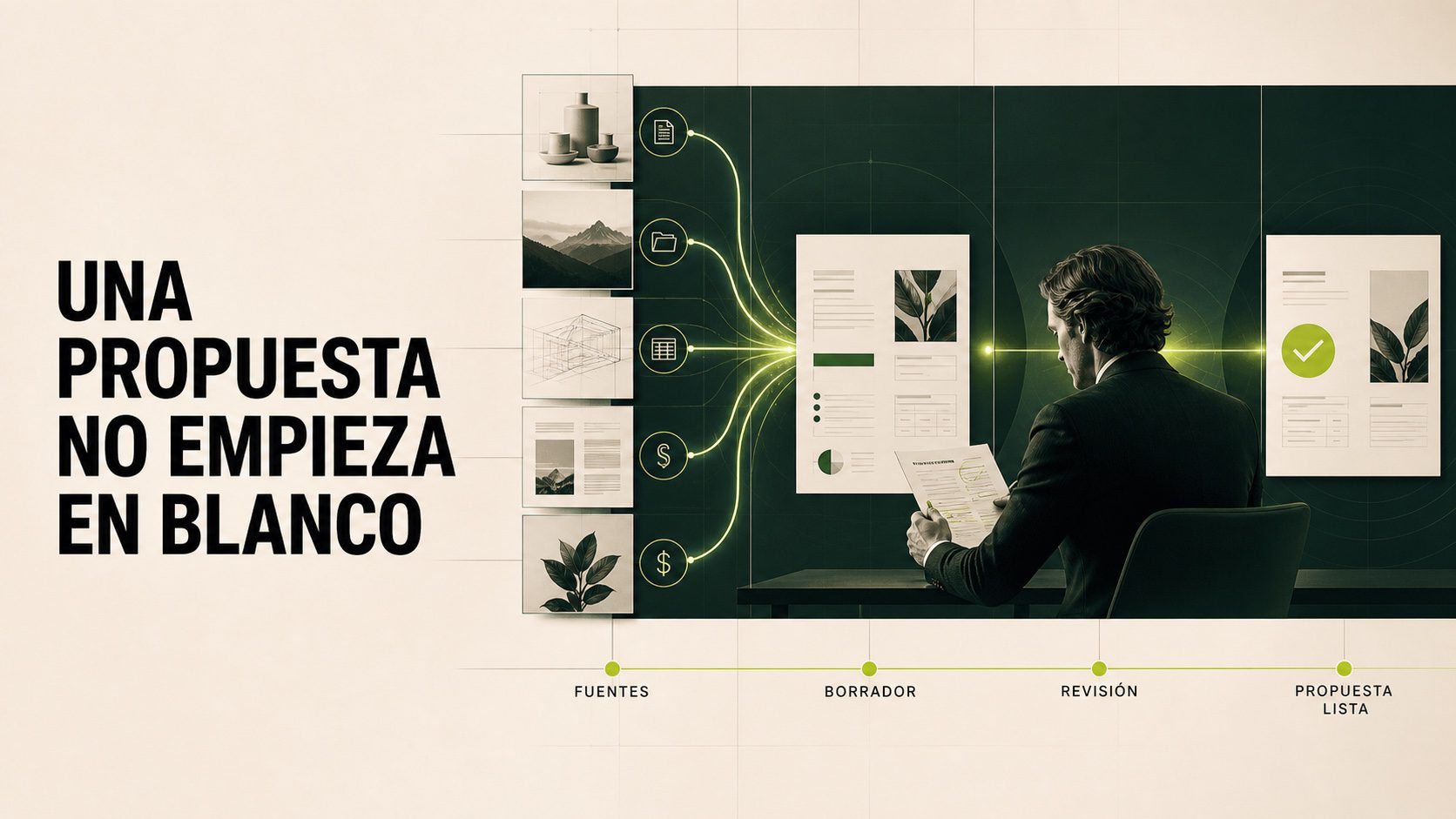
A proposal is not a writing exercise. It is a synthesis of scope, customer context, technical information, price, timing, risks, and commitments. When it is prepared under pressure, the problem is rarely that someone cannot write. The problem is that valid information is scattered and nobody is fully clear about what can be reused without changing the meaning of the offer.
AI is especially useful before the decision: extracting requirements, locating approved material, comparing versions, organizing an outline, and producing a first draft. Commercial, technical, and contractual judgment remains with the team.
A proposal fails before anyone reads it
Many proposals start late because the company begins with a blank document. Someone searches for a similar answer, another person finds an old presentation, the technical owner adds a qualification, and the salesperson reconstructs the case against the clock. It is a slow way to work, but above all it is difficult to review: the source of each statement is not always clear.
A well-designed support system does not ask a model to “write me a proposal.” It assigns more verifiable tasks:
- Identify the requirements in a request, RFQ, or briefing.
- Separate commercial, technical, and documentary questions.
- Locate approved sources that address each section.
- Propose an outline and first draft, with visible gaps when information is missing.
- Allow the responsible people to correct, approve, or reject each part.
The difference may seem subtle, but it is decisive. Instead of pretending to be certain, the system reveals what still requires an answer.
Five tasks where AI can add value
1. Extract requirements from a long document
A commercial request often mixes explicit requirements, open questions, dates, appendices, terms, and response criteria. AI can propose a structured list for an owner to review. It should not interpret an ambiguous requirement on its own; it can reduce the work required to locate it.
2. Create an ownership matrix
Once the questions have been identified, the system can organize them by type: commercial, technical, legal, financial, or documentary. This helps prevent a proposal from reaching the final stage without someone having taken responsibility for a critical section.
3. Retrieve approved content
Cases, technical sheets, frequently asked questions, references, and previous answers can be useful when their source and validity are known. AI can help find them; it does not automatically turn old text into a valid statement for a new customer.
4. Prepare a traceable first draft
The purpose of a first draft is not to replace the final proposal. It is to give the team a foundation it can correct quickly, while preserving the link to the sources used and identifying missing information.
5. Compare versions and detect gaps
AI can help flag an unanswered section, a variation between versions, or a requirement that does not appear in the outline. It supports review; it is not automatic validation of technical consistency, price, or contract terms.
What the evidence teaches us—and what it does not allow us to claim
An experiment published in Science evaluated 453 professionals performing writing tasks and found that the group with access to a generative tool completed the tasks in less average time and achieved a higher average evaluated quality. The context did not involve commercial proposals, quotes, contracts, or technical specifications. It therefore cannot be used as a promise of savings or quality for a particular company.
The study is useful for another reason: it shows why drafting, outlining, and rewriting are reasonable tasks to test. Validating a price, a supply term, or a customer promise requires knowledge that is not guaranteed by the formal quality of a text.
An experiment described by the Harvard Business School AI Institute involving 758 consultants also underscores that AI performance varies by task. In exercises that fell within the model’s capabilities, participants improved speed and evaluated quality; outside that range, results were not uniform. For a commercial proposal, the prudent conclusion is to work with bounded tasks and expert review, not delegate the entire process.
The five decisions that should not be delegated
- Price and margin. Including discounts, cost structure, and exceptions.
- Scope and timing. What the company agrees to do, deliver, or maintain.
- Technical specifications. Especially when an incorrect detail changes the solution being offered.
- Contractual or regulatory commitments. AI does not replace legal, technical, or compliance review.
- Final approval. Someone must take responsibility for the version the customer receives.
Accountability cannot be automated. It can be documented more clearly, assigned earlier, and supported with better drafts.
The minimum approved-source system
Before creating an extensive library, define a simple record for every source the company wants to reuse: document type, owner, review date, use category, and link to the original. An answer can be good and still be inappropriate if it belongs to another market, contains an expired term, or describes a scope that is no longer offered.
NIST’s generative AI profile highlights the importance of data and content provenance and traceability. Translated into commercial work: if a sentence reaches a proposal, the team should be able to know which approved source it came from, who reviews it, and why it remains appropriate for that case.
How to run a controlled pilot
Start with a repeatable family of proposals: one type of service, one product line, or one frequent commercial response. Limit sources to a reviewed set. Define which tasks AI prepares, what each person reviews, and which version is considered final.
Before expanding, measure the real work:
- Time spent searching for approved information.
- Time to a reviewable first draft.
- Number of material corrections before sending.
- Percentage of reused content with an identified source.
- Questions still unanswered when the proposal reaches review.
These measures do not establish a universal ROI. They help determine whether the workflow is clearer and whether it deserves a broader scope.
If the main problem is not writing but finding valid information, it is better to start by organizing commercial knowledge. If the proposal loses momentum after a conversation, the next focus may be CRM and follow-up. The tool comes after the decision about the workflow.
Does preparing proposals require searching for too much information?
E2M can review the workflow, sources, and necessary boundaries to choose an initial pilot the team can validate.
Sources and limits of this guide
- Science: Experimental evidence on productivity effects of generative AI. Professional writing tasks; not proposals, prices, or contractual documents.
- Harvard Business School AI Institute: Navigating the Jagged Technological Frontier. An experiment with consultants; it does not prove the commercial, technical, or legal quality of a proposal.
- NIST AI 600-1. Generative AI risk guidance; it does not certify tools or outcomes.